Election Year: High Interest. Low Power,
Election Year: High Interest. Low Power.
"It's not the parents that drain me. It's not the teachers. It's the Board."
Twelve years as a Superintendent, and it was like she'd finally given herself permission to say it out loud. "It's so clear now," she said, laughing.
I asked what she meant. I already had a guess.
She'd spent all twelve of those years reporting to people who ran for their Board seat on a promise to change the district. Test scores were down, discipline was inconsistent, or the district had lost touch with parents, and someone in the community decided the Board needed a voice to come in and fix it. Every election brought someone new into the boardroom, still moving at campaign speed. Yard signs. Campaign slogans. Then they won, walked into their first meeting, and sat down across from the one employee they managed. Her.
"They come in still running," she said. "And the boardroom is built to move a lot slower than they're expecting."
That's not an issue. That's the intentional design. A policy change takes public readings before anyone votes on it. A staffing decision waits for the Superintendent's recommendation. Nothing moves until the Board votes to move it together. Almost nobody explains any of this to a newly elected Board member before they arrive with a “mandate from the community” and a campaign's worth of adrenaline still in their legs.
Here's the part that took this Superintendent years to see, and the part she was really laughing about. One Board member cannot reassign a teacher. Cannot rewrite a curriculum. Cannot walk into a school and change how a classroom runs. All of them together can direct exactly one person: the Superintendent. Most Board members do not understand this on election night. Some never fully figure it out.
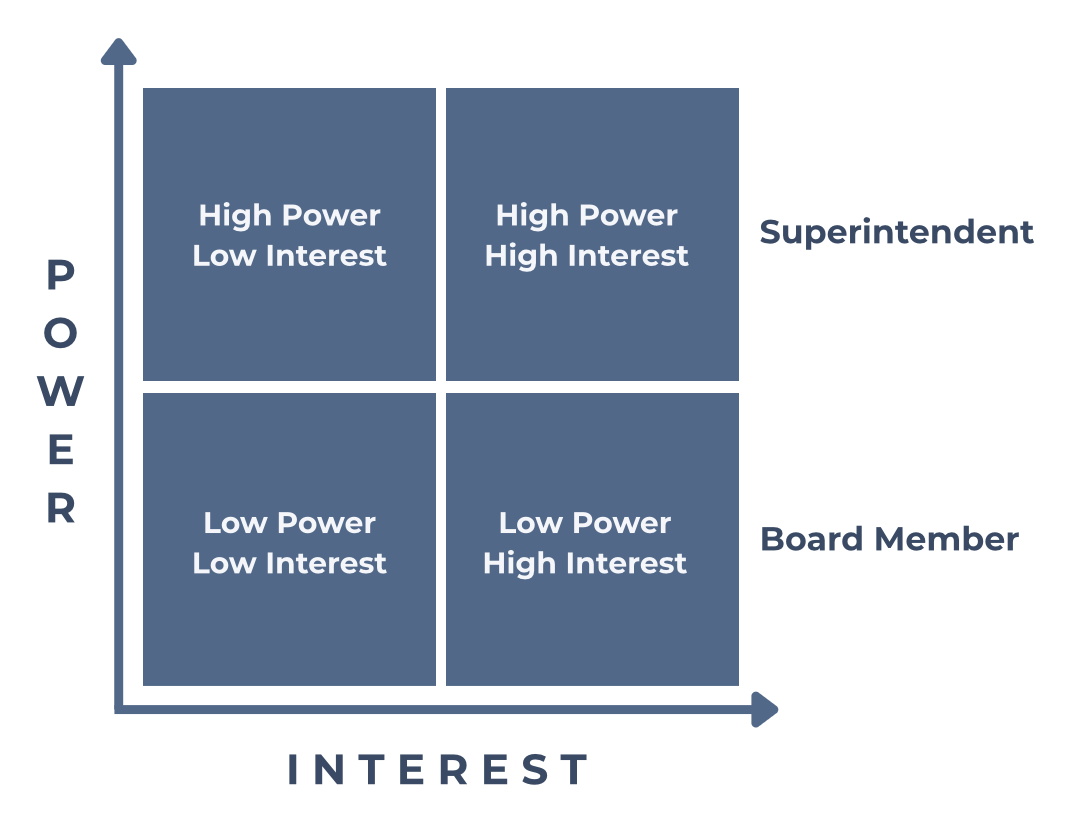
There's an old framework for this; picture a square, cut into four boxes. One side measures how much someone cares, their interest in the district. The other measures how much power they actually have. Board members land in one box: high interest, low power. Most Superintendents live in the box across from them: high power, high interest of their own. Same district. Same level of interest but different levels of power. There’s often alignment about what they want but neither one can fully see the other's perspective from where they're standing.
The Board is elected. It needs to be developed.
That's the dynamic, and it shows up in almost every school district I've ever worked with. Someone arrives with energy, conviction, fresh legs, and far less actual authority than they assume. Most Superintendents respond by managing around the Board, sharing less, hoping to keep the board in a tight lane. Others wait it out, hoping time will make things better.
Neither works. The Board never learns its own role, showing up meeting after meeting a little more frustrated that its energy never seems to move anything.
Here's what I want every Superintendent to hear. This starts with you. New team members do not need to be worked around. High interest is not something to manage. It is a leadership team waiting to be developed.
That development is not complicated, but it does need a Sponsor.
The Superintendent has to be the one who sponsors it, for the Board, for themselves, and for the Cabinet, so all three become one leadership team that actually works for the district. There's a path to get there. Clarity first, so every member of the Board and Cabinet knows the objectives and the way to reach them. Alignment next, so they share the same definition of what success looks like for the district. Cohesion, so every member of the leadership team knows how to partner together in their unique roles. Put off developing leaders at this level, and you'll spend years managing people who still think they can make any change they want.
This Superintendent I went out to lunch with is now retired. She doesn't have to manage a Board anymore. But she still laughs about it, because she finally understands what she was actually doing all those years. She was never just running a district. She was developing the people who had the role of managing her.
If you recognize your Board in any of this, or you're bracing for the version that walks in after the upcoming election, you don't have to manage around it. This is exactly the work Warrick does with Superintendents, their Cabinets, and their Boards: building the clarity, alignment, and cohesion that turns high interest into an effective leadership team.