
January has a predictable rhythm.
Emails start stacking and calendars refill. Leadership teams feel the pressure to show momentum. Something must be said or launched. The year needs to feel started. January looks productive, but it rarely is.
What usually follows isn’t chaos… its weight.
Priorities pile up before anyone can sort them. Ownership sounds clear in the room but blurs in practice. Meetings happen, but decisions don’t. People stay busy, yet the work feels heavier instead of focused. By February, teams feel off track. They’re carrying too much, but no one can pinpoint when it happened. That stall almost never comes from a lack of effort. It comes from too much arriving at once.
I know this feeling well. I’ve been an entrepreneur for almost thirty years. From painting houses to building a 20+ year career in workforce development, every January I feel it. The push to get going, the weight of deadlines arriving before the year has even started. The calendar fills immediately, and I still can’t help but wonder, “Are we doing enough?”
I also feel responsible. I have a team. I want to give them clarity. Direction. Momentum. New targets. A clear vision for where we’re headed. And if I’m honest, I can feel myself pushing. What I’ve noticed over time is that the harder I push, the less responsive the team becomes. Not because they don’t care, but because they’re still finding their footing. Just like I am.
There’s good reason for this. Decades of cognitive research have shown that human working memory is limited. George Miller’s early work in the 1950s, and later research by John Sweller on Cognitive Load, all point to the same reality. When tasks, goals, and half decisions pile up, something erodes. And it is something we all crave right now… being effective.
This overload is exactly what we see when goals are introduced before the team is ready. It feels like carrying too many bags at once. Nothing is wrong, but everything feels heavy. The work still gets done, but it takes longer than it should. Decisions cost more energy than expected because our mind is already full.
Productivity needs a new definition.
It is not about how much people do. It is about how much meaningful work they are actually focused on.
Research from high stakes environments shows that decision lag, how long it takes to decide and act, matters far more than busyness. When clarity is missing, action slows no matter how hard people work.
The same pattern shows up in everyday work. The same pattern shows up every day in teams. Calendars fill. Tasks pile up. Energy drains. Motion increases, but progress slows.
Real productivity is what is left in your mind at the end of the day. Are you drained by volume, or clear because you focused on the right things? Productivity is mental space. It is the ability to make thoughtful choices instead of reacting all day long.
This is why January matters.
The most effective leaders I know resist the urge to rush the start of the year. They don’t confuse motion with productivity. They slow things down long enough to notice what’s actually happening with their team. It’s like they put themselves on a scale, not to judge, but to see what they’re carrying. What do they feel responsible for? What is their focus? What trust looks like. Which tensions followed the group into the new year and haven’t been named.
None of that shows up as strong momentum in the beginning. But it shapes how everything else unfolds.
Most productivity advice still points in the same direction. Do more. Move faster. Fill the time. It sounds reasonable until you watch what happens over a few months. When the pace is set too early, everything feels urgent and people are always catching up. The year becomes a cycle of corrections instead of real progress.
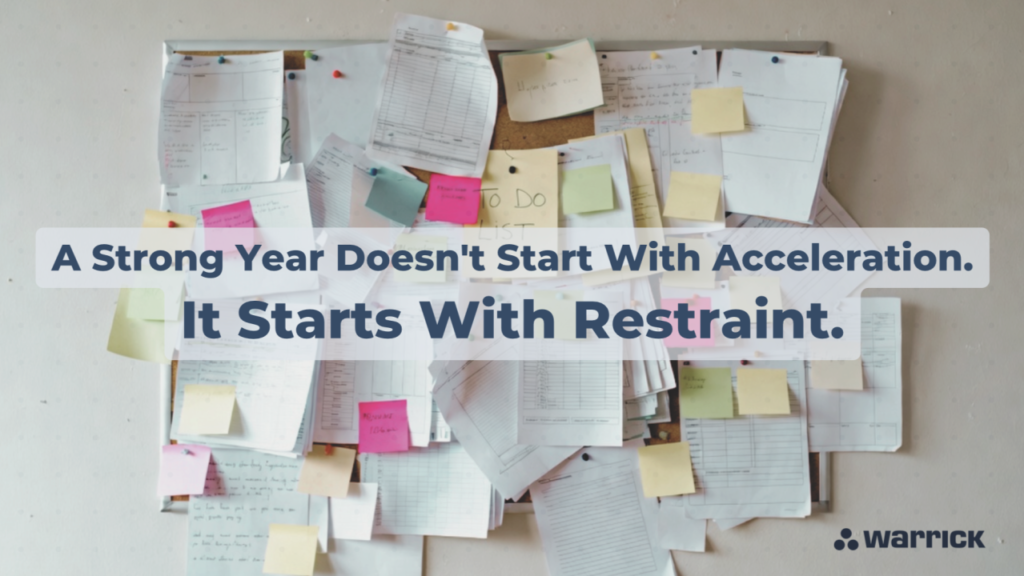
A strong year doesn’t start with acceleration. It starts with restraint.
Goals matter, but they should not lead the conversation. When they come before clarity, focus, and shared understanding, they create pressure instead of direction. Teams know what to aim at, but they are not given a way to move together.
If you want a strong 2026, don’t start the year with goals.
Start by slowing the team down long enough to see what actually needs attention. I know this may seem impossible this week, but set aside an hour to get clear on where you are going. Clarity is what makes progress feel lighter, not heavier. That quiet work is what allows goals to matter later.
Need help getting clear on what matters this year? This is what we do. Let’s schedule a one-hour call to focus on your priorities and next steps.