
“Fingers crossed things turn around soon for us!”
How defeating is that to hear when nothing feels aligned, deadlines are closing in, and the support you need is nowhere to be found? This is how most people use hope, as a filler. I’ve muttered it under my breath too, mostly to cover up the fact that I didn’t have a real plan. It’s the leadership equivalent of a shrug with a smile, tossed out when you don’t know what else to say.
But high performers do not treat hope this way. They see it as a strategy. And when they lead with it, the environment shifts before the circumstances ever do.
When Chaos Hits
Last spring, I was coaching a leader through one of those weeks where everything felt like it was falling apart: key people were leaving and revenue numbers were dropping. The kind of week where you start wondering if “resigning gracefully” counts as a strategy. If you have ever been in that position, you know that instinct that tries to fill gaps and hold it all together. Survive.
We were on the phone, quiet, both of us absorbing the storm he was facing. And instead of jumping in, he did something unexpected. He leaned back…and waited. Not a long wait, just long enough that both of us began to shift in the space around the conversation. I caught myself holding my breath as he asked, “What do we actually want this to look like three months from now?”
That question wasn’t a plan yet. It was a pause that opened space to imagine a better outcome, to see that a path forward existed. Hope, in that moment, wasn’t a filler. It was the quiet belief that a more productive future was possible and that the steps to get there could be discovered together.
I was supposed to be the coach, but that day I was learning from him. The pause gave us a new starting point and belief that hope could be possible.
Hope ≠ Fluff
Let’s rewire something here: Hope is not passive or superficial. It is a choice, a strategy that shows the way forward.
And I’ll be honest, I don’t always make it. Like my client, I find myself responding to the chaos around me, instead of stepping back to ask what could actually change. I need to pause, see the bigger picture and map a path to get there. That’s the first hopeful move each of us can make.
When a leader truly believes in a better outcome and takes real steps toward it, people follow. Not because they are crossing their fingers, but because they start to see how things can get better. Belief alone is not a game-changer. Hope only works when paired with action.
Early in my career, I didn’t understand this. I treated hope like a feeling, not a strategy I could use. Every Monday, I gave myself a pep talk: “I can do this!”, but that would quickly fade as the midweek uncertainty crept right back in. It took stumbling through being an entrepreneur for me to realize that hope could be a playbook. A few years ago, it clicked. Strategy without action doesn’t make a difference. Your moves are what make it real.
Picture this: It’s Saturday morning, and the garage has been piling up for months. Your first inclination is to grab whatever is on top and start moving it around, but frustration hits fast. Then, you pause. You picture the finished space; shelves cleared, floor visible, everything in its place. That image is your hope.
You start touching boxes, deciding what belongs where, taking deliberate steps instead of diving in headfirst. That is agency in action. As you sift and sort, the picture of completion stays in your mind, guiding each move. Vision and action, together, get you from a disaster zone to a finished space.
Leadership follows the same pattern as clearing a garage: See. Sort. Move. Hope guides every step. It works for garages, projects, and most importantly, for helping your team believe that forward momentum is possible, even in the middle of chaos.
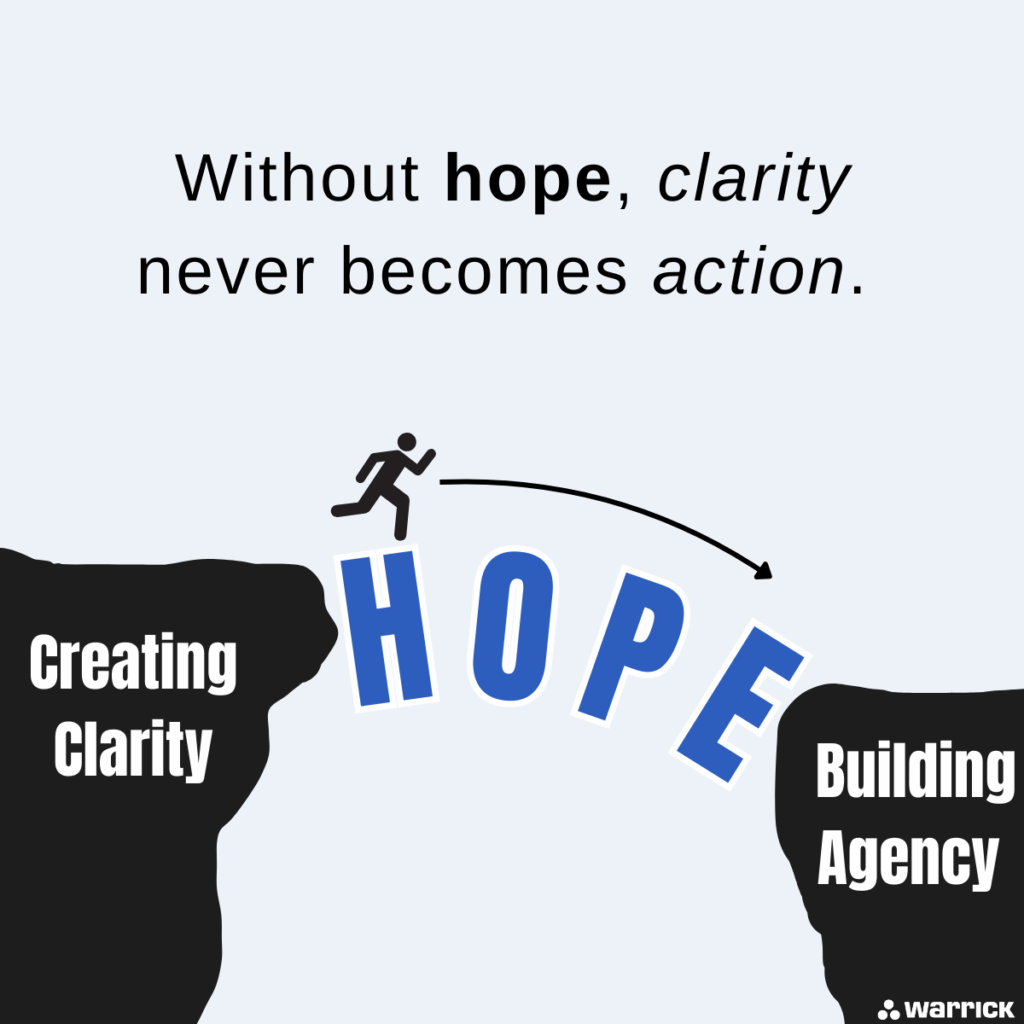
Hope = Clarity + Agency
Leadership comes down to two simple things: creating clarity and building agency. Hope lives in the space between these two. It gives your team a clear picture of a future worth moving toward. Agency then turns that picture into tangible progress. When you lead with both, you stop waiting for circumstances to change and stop looking for someone else to take the first step.
You step in and act. Others follow, not because you have all the answers, but because you are willing to take the first step and show a path forward. The truth is, I rarely feel brilliant in these moments, and I am often just figuring it out as I go. But people follow, because someone simply believed we could work it out together. Influence grows when that belief is clear enough to get things moving, proving that hope is a strategy in action.
I have stopped pretending to have all the answers. These days, I focus on being the first one willing to move. Hope works the same way. It is not magic, it is momentum. Think of it like cleaning out the garage: you pause to see what it could be, sort what is in the way, and then move. Small, deliberate steps turn a mess into progress. And that is often enough to get everyone else moving too.
Here’s how HOPE WORKS in three simple steps, using the garage as our guide:
See: Pause and picture the finished space. That image is your hope, your guide for what is possible.
Sort: Organize what is in front of you. This is agency in action, the work that moves hope off the page and into reality.
Move: Pair your sense of direction with action and keep taking steps forward. This is what turns progress into momentum that others can follow.
Why it works: Hope doesn’t erase the chaos, but it uses it. It gives you and your team a picture worth moving toward and the courage to take steps that matter. That is why hope, guided by clarity and agency, becomes the strategy leaders rely on when the path ahead is unclear.